
The Most Difficult Game is ‘Being’
on ouroboros

I haven’t had much to say these last couple of months. I like to think of it as the virtue of liminal space. When you’re within stasis and momentum, existing between words instead of within them, you have the virtue of stillness. At least for a moment.
I’ve spoken to the cards less often. Some nights ago, though, I regarded them again for the new year. It was a Death card spread rather than one typically reserved for the new year. I do not see the Death card as something potent; rather, it is more of an ouroboros. The snake eats itself. The end is also a beginning.
Recently, I’ve been learning about thermodynamics. I wasn’t very interested in the subject until I read a piece on Aeon about the metaphysics of reality. Drew M. Dalton writes:
“According to the laws of thermodynamics, all that exists does so solely to consume, destroy and extinguish, and in this way to accelerate the slide toward cosmic obliteration.” (Dalton, 2025)
Through the laws of thermodynamics, Dalton explains that all of life leans towards entropy:
“Life is perhaps the most effective, albeit least obvious, consequence of and agent for thermodynamic decay in our immediate system, [...] Everything in existence, including our species, both arises from and works in service to the destructive order of reality. Decay, it seems, is the ultimate essence of existence, which means that our being must be understood as a mode of unbecoming. It is but one additional way in which the ultimate annihilation of the Universe is accomplished.” (Dalton, 2025)
In tarot, the Death card is assigned as the fundamental basis of a spiritual path, as it leads from one transformation to another. This sense of transformation and basis for spiritual life is even written in the bible:
Romans 8:6 The Mind governed by the flesh is death, but the mind governed by the Spirit is life and peace.
From the perspective of the tarot journey through the major arcana, the Fool cannot move forward without acknowledging some damage to its sense of self. Thus, the Fool can do nothing else but release what they cannot change to continue on their own path.
In a way, becoming is a way of unbecoming. Ouroboros.
When I regarded the cards, they spoke less of motion and movement and more of finality. Dalton marks this natural cycle of life as something in pursuit of its own obliteration; everything eats and is eaten.
Perhaps metaphysics has already drawn on this for as long as it needed to. Perhaps, you too, can sit with the idea that all beings draw toward their own annihilation. But it’s different, perhaps, to assess the metaphysics of absolute finitude and inescapability. It’s the acceptance of finality that our minds cannot grasp.
I watched the ‘3-Body Problem’ on Netflix around late December. The series is adapted from the novel series written by Liu Cixin with the same name. In short, a young astrophysicist during the Cultural Revolution in 1960s China manages to make contact with a doomed civilization on a distant planet orbiting around 3 suns. The alien invasion is not one you might see in a Marvel movie – this one spans decades. Through a mysterious virtual reality game, humanity must reconsider its understanding of physics before the aliens’ arrival in 400 years.
The astrophysicist, once reaching contact, is warned not to respond because these aliens make it quite clear, humanity will be destroyed. Still, she responds, with a message reading: “Save us. We cannot save ourselves.”
These aliens begin by attacking their science, and while particle accelerators give wild results, humans deem them “inaccurate.” Only they are not inaccurate at all – in truth, there is a force so powerful and so unknowable, it threatens the very nature of humans’ understanding of science. What the hard sci-fi portion of this series is is the clear understanding that humanity is being destroyed, yet not just physically.
Interestingly, following the astrophysicists’ remarks about the fundamental nature of humanity, a cult-like group of followers forms and prepares for the arrival of this alien species, even going as far as calling them “Lord.” Their personal ideas of doom come with salvation, but aliens do not know of such a thing as God, nor can they conceptualize such a thing as lying.
This is perhaps what’s most grim about our primitive human minds: we cannot conceptualize death. Death is the ending of something, but both religious and spiritual practices tend to describe it as the beginning of something else. This is why Dalton posits reality is evil:
“We must acknowledge that reality – which is organised antagonistically against all that it creates, and is the direct cause of the suffering of every entity it endows with consciousness – might be morally evil.” (Dalton, 2025)
Finality or finitude is that force which is so unknowable and powerful. We try to use language to translate our grief; we use poetry to mend the anger. But it cannot be explained as it is, in all its banality, I don’t think. I suppose, when you watch the world as it burns, or the people who suffer at the hands of governments or even other humans, are you willing to stomach the idea that this is just how things are? That this is all reality is?
I regarded the cards again, believing there might’ve been something I missed. There was a new development.
In the Thoth tarot deck, the suit of swords refers to Chokmah, representing a profound, divine insight beyond mere knowledge. He is the first manifestation.
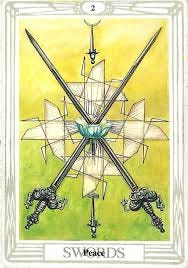
The two of swords was previously referred to as “the Lord of peace restored”, but evidently, the word “restored” is incorrect. Thus, we shall call it ‘the Lord of peace’. Since this suit governs all intellectual manifestations, those arising from nothing else, they are complicated and require a great deal of thinking.
The Lord of Peace appears as two swords crossed, united by a blue rose with five petals. The rose is meant to harmonize with the antagonism native to the suit, and the geometrical symbols behind it are meant to represent the emphasis on the equilibrium of the symbol. The suit of swords abides above the onslaught of disruption, in essence.
The Lord of Peace represents the beginning of analysis, after the first of the suit of swords represents the first manifestation of thinking. Here, the mind is at its best to administer potentials. Upright, it signifies balanced force, acceptance of contradictions, and a good compromise between soul and mind. Its shadow, or reversed, position shows difference, disagreement, and unsolved tensions.
A few days before Christmas, my grandfather’s brother passed away. I thought about death for a long moment as the days passed. I thought his funeral would shake me, and it did not. As my mother cried, I couldn’t help but feel still. I was not indifferent – I was simply trying to understand that all life, eventually, reaches its unraveling. I rubbed my palms together. I thought I was a bad person for being the one to look forward and say, “This is how things are.”
There’s something my grandmother says quite often: From God we came, to God we must return.
There is nothing to return to, just as, perhaps, there is nothing before life itself. Was the sun something else before it became the sun? What will it be once it burns out – nothing but gas? That’s something else entirely, though.
With the two of swords at the center of this collapse – both my internal one and the one that comes from sudden, unprecedented death – I am beginning to feel less like a child holding a double-edged sword and cutting myself with both ends, and more of a blindfolded warden holding it at its middle.
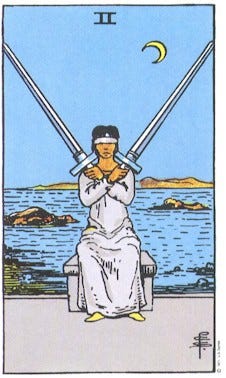
In most traditional tarot cards, the figure on the card is blindfolded. This is because it is a representation of how we are forced to navigate on intuition, intellect, or through a deliberate pause meant to allow us to listen to truth, whilst being unable to see a situation completely clearly.
If thermodynamics has taught me anything, it is that we are not playing God; we are playing force.
You have to constantly keep looking down at your hands and asking what force you will create next. I keep asking myself what it will be.
I am choosing to abide by the truce of the Lord of peace. I do not know everything, but that does not mean I know nothing.
I am still sitting on the wooden church bench, rubbing my palms together. I don’t really have any answers. Every time I ask the world: Is this all it is? It just keeps answering, yes.
I am thinking of getting back into doing newsletters again! (Though I think a question-and-answer portion might be something fun.) If you have any questions — and this can range from asking about spacetime to my favorite kind of brownie — then please feel free to message me! With enough questions, I think I can cook something up. If I don’t get many, then I can always just write a piece about one specific question.
Anyways. Happy New Year, everyone!